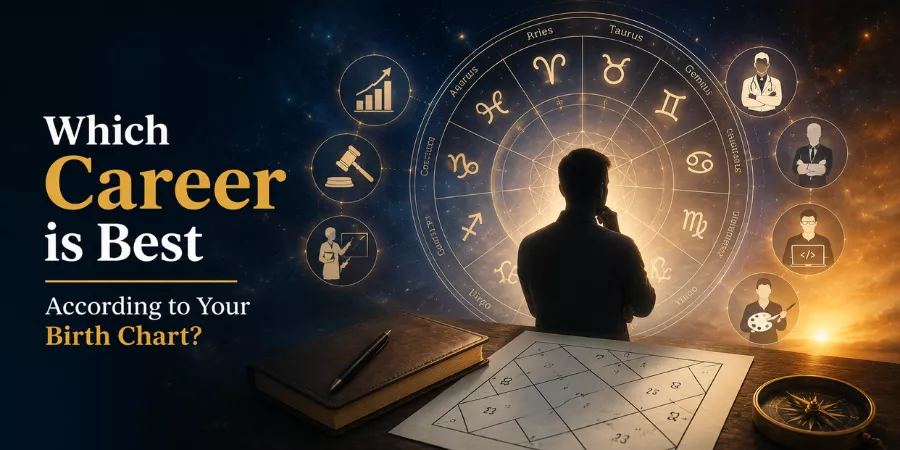
Career astrology examines the 10th house of your birth chart, its ruling planet, Saturn’s placement, planetary periods called Dashas, and the divisional D10 chart to identify professional strengths and timing. Your Sun sign gives broad tendencies. A full birth chart gives something far more specific, and far more useful.
Key Takeaways
- The 10th house is the primary indicator of career in any birth chart
- Birth chart analysis is more precise than zodiac sign alone
- Planetary periods (Dashas) reveal when career shifts are likely
- Different planets support different professional paths
- Astrology works best alongside real-world skills, education, and self-awareness
27% of US adults say they believe astrology can affect their lives, according to Pew Research Center’s October 2024 survey. That is roughly one in four people. Among those under 35, 63% believe astrology has positively influenced their career decisions, and 15% credit it with helping them land their dream job, per an EduBirdie study.
Whether you find those numbers surprising or completely believable says a lot about where you stand on this. But the more interesting question is not whether astrology is real. It is whether it can give you a useful framework for understanding your professional strengths, one that goes deeper than a personality quiz and broader than a job title.
The global astrology market was valued at $14.3 billion in 2024 and is projected to reach $27.15 billion by 2035, according to Market Research Future. That is a mainstream one, growing steadily, and a significant portion of that growth is driven by career-related consultations.
What Determines Your Career in Astrology?
Career astrology does not work the way most people assume. Googling your Sun sign and reading “Aries makes a good leader” is to astrology what reading a single lab result is to a full medical diagnosis. It gives you one data point. A birth chart gives you the whole picture.
The analysis rests on several layers working together:
The 10th House is the most important. It represents public life, profession, ambition, and reputation. Whatever sign sits at the cusp of the 10th house, and whichever planets occupy it, immediately shapes the broad nature of the career, whether it tends toward public service, creative work, technical fields, or business.
The 10th House Lord is the planet that rules the sign on the 10th house cusp. Its placement by sign, house, and strength tells you how that career energy actually manifests. A well-placed 10th lord in a strong house suggests professional confidence and forward momentum. A weakened 10th lord in an enemy sign tells a different story.
Saturn runs career astrology in a way no other planet does. It rules discipline, structure, effort over time, and long-term rewards. Its house placement, sign, and whether it aspects the 10th house all influence the type of work someone gravitates toward, and how much grind is involved in getting there.
Mercury, Sun, Jupiter, Mars, Venus, and Moon each contribute specific career themes depending on their strength and placement:
| Planet | Career Themes |
| Sun | Leadership, government, administration, politics |
| Moon | Healthcare, hospitality, caregiving, public relations |
| Mercury | Writing, communication, technology, finance, analysis |
| Venus | Design, fashion, luxury, arts, entertainment |
| Mars | Engineering, military, surgery, sports, real estate |
| Jupiter | Education, law, consulting, philosophy, banking |
| Saturn | Manufacturing, infrastructure, management, mining |
| Rahu | Technology, foreign companies, innovation, media |
| Ketu | Research, spirituality, analytics, investigation |
Is Zodiac Sign Enough to Predict Your Career?
Not really, and most serious practitioners of career astrology would say so directly.
Sun sign horoscopes are written for twelve groups that collectively contain billions of people. They provide useful tendencies, not specific predictions. A Capricorn Sun does suggest ambition and structured thinking, but whether that Capricorn becomes a CFO, a structural engineer, or a government administrator depends entirely on where Saturn sits, how the 10th house is configured, and what Dasha period is active.
Career astrology by date of birth, ideally with birth time included, gives the full natal chart, which is specific to a moment and location, not a month-long window. That specificity is what makes the difference between broad guidance and something genuinely applicable.
Which Career Matches Each Zodiac Sign?
These are tendencies, not prescriptions. Modern careers blend multiple planetary energies.
| Zodiac Sign | Career Tendencies |
| Aries | Leadership roles, startups, defence, sports management |
| Taurus | Finance, real estate, food industry, luxury goods |
| Gemini | Journalism, content creation, sales, data analytics |
| Cancer | Healthcare, education, social work, hospitality |
| Leo | Media, politics, performing arts, executive leadership |
| Virgo | Research, medicine, auditing, UX design, editorial |
| Libra | Law, diplomacy, design, brand strategy, mediation |
| Scorpio | Investigation, psychology, surgery, fintech, intelligence |
| Sagittarius | Higher education, publishing, law, travel, philosophy |
| Capricorn | Corporate management, architecture, government, banking |
| Aquarius | Technology, social enterprise, AI research, innovation |
| Pisces | Healthcare, film, spirituality, marine sciences, therapy |
Modern Careers and Planetary Combinations
This is where career astrology readings get genuinely interesting, particularly when applying classical planetary themes to professions that did not exist a generation ago.
An AI engineer tends to show strong Mercury (logic, systems) combined with Rahu (technology, the unconventional) and often Saturn (precision, long build cycles). A UX designer typically reflects a Venus-Mercury combination, aesthetic sense meeting analytical thinking. Product managers often show a Sun-Mercury-Jupiter blend: vision, communication, and strategy working together.
A startup founder almost always has a strong Rahu influence, the planet associated with disruption, ambition, and paths that break from convention. Combine that with an active Mars (drive, risk tolerance) and a well-placed Jupiter (expansion, optimism), and the profile becomes recognisable.
Digital marketers tend to show Mercury-Rahu energy. Financial analysts lean Mercury-Saturn. Surgeons classically show Mars-Sun with Saturn providing the steadiness that high-precision work demands.
These are patterns, not predictions. Someone with a strong Mars who becomes a surgeon made choices, pursued education, and worked through training. The chart does not make decisions. It describes inclinations.
Job or Business: What Does Your Birth Chart Suggest?
Career astrology readings often surface one of the most practical questions clients bring: should they work for someone else or build something of their own?
A few chart factors help clarify this:
The 7th house governs partnerships and, in Vedic astrology, is often associated with business ventures conducted with others. A strong 7th house with benefic planets suggests capacity for collaborative enterprise. The 10th house combined with the 11th (income and gains) tells the story of whether professional efforts tend to convert into financial return.
Saturn strongly placed in the 1st or 10th house often indicates someone built for sustained professional effort, the kind that service or salaried roles reward over time. A powerful Rahu-Sun or Rahu-Mars combination in key houses often correlates with entrepreneurial restlessness and the willingness to operate outside established structures.
The Atmakaraka, the planet with the highest degree in the natal chart in Vedic astrology, is also worth examining. It represents the soul’s primary direction in this lifetime and often points toward the domain where work feels most meaningful.
Can Astrology Predict Career Timing?
Yes, astrology does try to forecast when career moves will take place by interpreting particular houses (i.e. 10th for profession and 6th for employment) and planetary periods or transits when potential opportunities for a job offer, a transition, or a raise would occur, but again these are not/were not supposed to be definite.
The Dasha system: A sequence of planetary periods that each last for years, rotating through the lifetime, is the primary timing mechanism. When a person enters the Dasha of the planet ruling their 10th house, or a planet strongly placed in the 10th, career acceleration often follows. When they enter the Dasha of a malefic planet unfavorably placed, professional challenges tend to emerge.
Saturn transits deserve particular attention: When Saturn crosses the natal Ascendant or 10th house cusp, events that happen approximately every 28 to 29 years, they typically mark significant professional restructuring. These are not necessarily negative periods, but they are rarely quiet ones.
The D10 chart, also called Dashamsha in Vedic astrology, is a divisional chart specifically designed for career analysis. It offers a more granular view than the natal chart alone and is most reliable when birth time is accurate to within a few minutes.
How to Read Your Birth Chart for Career: A Step-by-Step Checklist
- Find your Ascendant (Rising Sign): this sets the entire chart structure
- Identify the 10th house sign and any planets in it: this is the core of career astrology
- Locate the 10th house lord: find which house it occupies and how strong it is
- Check Saturn’s placement: house, sign, and whether it aspects the 10th house
- Note the current Dasha period: which planet is active and how it connects to career houses.
- Examine the D10 divisional chart: for a career-specific lens, especially for timing
- Cross-reference with the 6th house: it governs daily work, service, and workplace dynamics.
- Look at the 2nd and 11th houses: for income patterns and financial return from work.
A career astrology free AI tool can help with the initial chart calculation. For interpretation, especially around Dashas and the D10 chart, a detailed career astrology reading from an experienced practitioner adds considerably more nuance than automated output alone.
FAQs
Which house represents career in astrology?
The 10th house is the primary indicator of career, public reputation, and professional life in both Vedic and Western astrology. The 6th house governs daily work and service. The 2nd and 11th houses reflect income and financial return from professional activity.
Which planet is responsible for profession?
Saturn is the primary planet governing career, effort, and long-term professional structure. The Sun indicates authority and leadership. Mercury governs communication and analytical work. The 10th house lord, whichever planet rules the sign on the 10th cusp, is also central to career analysis.
Can astrology predict career success?
Career astrology can identify periods of professional opportunity and challenge, and highlight the types of work most aligned with a person’s chart. It cannot guarantee outcomes. Real-world success depends on skill, effort, opportunity, and timing, which astrology can illuminate but not replace.
Can astrology predict a career change?
Yes, with reasonable accuracy in timing. Saturn transits through the 10th house and transitions between major Dasha periods are the most common indicators of career change. Career astrology predictions work best when birth time is accurate and the D10 chart is examined alongside the natal chart.
Which birth chart is used for career?
The natal chart is the starting point. The Dashamsha (D10) divisional chart is specifically used for career analysis in Vedic astrology. Transits and the current Dasha period are then layered on top for timing.
Is birth time required?
Accurate birth time is important for precise career astrology by date of birth. It determines the Ascendant and house cusps, which are essential for 10th house analysis. Without birth time, only planetary placements by sign are available, useful but significantly less specific.
Can astrology tell if I should start a business?
Chart factors associated with entrepreneurship include a strong Rahu, active Mars, a well-placed 7th house lord, and combinations involving the 10th and 11th houses. A career astrology reading can identify whether the chart supports independent enterprise, and when timing may be favorable for launching one.
Which planet indicates government jobs?
The Sun is the primary indicator of government service, administration, and positions of authority. Saturn also plays a role, particularly in roles involving public service, infrastructure, or long-term institutional work. Jupiter indicates positions in judiciary, education, or civil advisory roles.
Which planet indicates creative careers?
Venus governs creative fields including design, fashion, arts, luxury, and entertainment. A strong Moon supports creative work involving public engagement, storytelling, or caregiving. Mercury contributes to creative writing, content, and communication-driven creative roles.
Which zodiac sign has the best career prospects?
No single sign has universally better career prospects. Career potential in astrology is determined by the full birth chart, not the Sun sign alone. Capricorn is often associated with professional ambition and structure. Gemini with communication and versatility. Scorpio with intensity and investigative depth. But a chart with difficult placements in any sign can underperform, and a well-configured chart in any sign can thrive.
Conclusion
Career astrology offers something career counselling often cannot: a map of natural inclinations, timing windows, and long-term patterns that stretches across a lifetime rather than a single job decision.
52% of astrology app users report relying on astrology for decisions related to career and personal wellness, according to Global Growth Insights (2025). That number reflects a genuine need, not for certainty, which astrology cannot provide, but for a framework that makes self-understanding more structured.
The birth chart is a description of tendencies and timing. The 10th house shows the terrain. The Dashas show the seasons. What someone builds within that terrain depends on choices, preparation, and persistence that no chart can substitute for.
Used honestly, as one lens among many, career astrology by date of birth is a more sophisticated tool than most people give it credit for. The mistake is treating it as a verdict. The value is in treating it as a map.