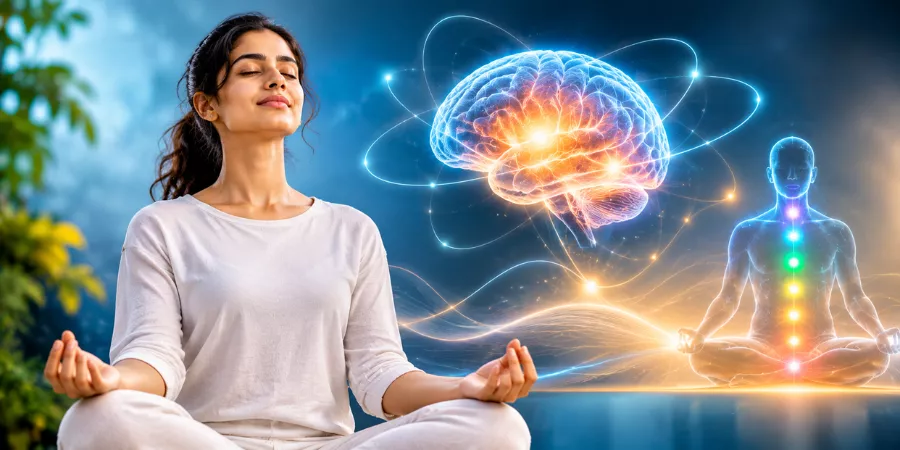
Many people want to believe the mind holds more power over the body than medicine has admitted. That the right thoughts, held the right way, could change what happens inside the body. Quantum healing speaks straight to that hope. It also borrows the vocabulary of physics to do it, which is where things get complicated.
So, what does the term actually mean? What does the research say? And where does the evidence stop and the storytelling begin?
What is Quantum Healing?
Quantum healing is the belief that consciousness can influence physical health through quantum-level processes. Deepak Chopra popularised the phrase in his 1989 book Quantum Healing, which blended Ayurvedic ideas with concepts borrowed from modern physics. Today the label covers a loose mix of meditation, energy work, visualisation and “quantum” coaching.
It is not a recognised medical discipline. There is no standard training, no regulatory body and no clinical protocol behind it. Anyone can use the name, which is exactly why it helps to know what sits underneath it.
What Does Quantum Physics Actually Say?
Quantum mechanics describes how atoms and subatomic particles behave, and it is among the most heavily tested theories in science. Nothing in it says that thoughts can cure disease. Two claims cause most of the confusion.
- The observer effect: In physics, “observation” means a particle interacting with a measuring device. A conscious mind deciding to heal itself is not part of the definition. The word “observer” is where the misunderstanding usually begins.
- Quantum effects in the body: Warm, wet biological tissue is a noisy place for fragile quantum states. In a widely cited 2000 paper in Physical Review E, physicist Max Tegmark calculated that quantum coherence in the brain would collapse in roughly 10⁻¹³ to 10⁻²⁰ seconds. Neurons work on timescales of about 0.001 to 0.1 seconds, many orders of magnitude slower. By that estimate, the brain’s thinking machinery behaves classically.
Researchers do study genuine quantum effects in biology, such as in photosynthesis. None of that research shows that intention can treat an illness. Used as a mechanism for healing, “quantum” works as a metaphor, not as science.
What Does Science Say About the Mind-Body Connection?
The mind-body link is real, well studied and entirely explainable without quantum theory. Ordinary biology does the work.
Stress and the body
Chronic stress keeps the body’s stress response switched on, raising cortisol and feeding inflammation. The INTERHEART study, published in The Lancet in 2004, compared 15,152 heart attack cases with 14,820 controls across 52 countries. It found that psychosocial factors such as stress were linked to heart attack with an odds ratio of 2.67, accounting for around 32.5% of the population-attributable risk.
Infection tells a similar story. In a classic 1991 experiment reported in the New England Journal of Medicine, Sheldon Cohen and colleagues gave 394 healthy volunteers nasal drops containing common cold viruses and monitored them in quarantine. Higher psychological stress scores were associated with a greater chance of developing a cold, and the risk rose steadily as stress increased.
Loneliness and connection
Feeling disconnected carries physical costs too. A 2015 meta-analysis by Julianne Holt-Lunstad and colleagues found a 29% higher likelihood of death for people experiencing social isolation, 26% for loneliness and 32% for living alone. In 2023, US Surgeon General Dr Vivek Murthy issued an advisory noting that roughly half of American adults report feeling lonely, and likening the health risk to smoking up to 15 cigarettes a day.
The placebo effect
Belief and expectation can shape how symptoms feel. The evidence is more nuanced than popular accounts suggest, though. A 2001 review of 114 trials by Asbjørn Hróbjartsson and Peter Gøtzsche found no overall placebo effect on objective outcomes, and only a small effect on subjective ones such as pain. Later work has been more mixed, and some well-run trials show meaningful pain relief.
One of the more striking findings came from a 2010 trial by Ted Kaptchuk and colleagues. Eighty patients with irritable bowel syndrome were told plainly that they were taking placebo pills with no active ingredient. They still reported greater symptom improvement than the group given no treatment. Placebo can change how people experience symptoms. It does not cure underlying disease.
Mindfulness and meditation
A 2014 review in JAMA Internal Medicine pooled 47 trials involving 3,515 participants. It found moderate evidence that mindfulness meditation programmes improve anxiety (effect size 0.38 at eight weeks), depression (0.30) and pain (0.33). The effects were modest rather than miraculous, but consistent enough to take seriously. Results for stress-related outcomes were weaker, and the review found no evidence that meditation beat active treatments such as exercise or medication.
The gut-brain axis
Signals also travel in both directions between the digestive system and the brain through nerves, hormones and the immune system. That helps explain why anxiety can upset the stomach and why gut health appears to influence mood.
Taken together, this research supports a clear statement: mental state is part of physical health. It does not support the claim that anyone can think their way out of serious disease.
The Philosophy Behind the Idea
The debate predates quantum physics by centuries. In the 17th century, René Descartes argued that mind and body are two separate substances. That dualism shaped Western medicine for generations, treating the body as a machine to be repaired.
Many Eastern traditions took another path. Ayurveda and Traditional Chinese Medicine describe body, emotion and spirit as interwoven, so that illness in one place is rarely just about that place.
Modern medicine has moved toward the middle. In 1977, psychiatrist George Engel proposed the biopsychosocial model, which treats health as the product of biology, psychology and social circumstances together. It is now widely used across healthcare. Seen through that lens, quantum healing is a popular and slightly mystical way of pointing at something genuine: people are not machines made of separate parts.
The danger begins when philosophy is sold as proven physics. It deepens when “your thoughts caused this” turns into blame. Falling ill is not a failure of positive thinking, and recovery is not a test of mental discipline.
How to Explore Mind-Body Practices Safely
Interest in the mind-body connection does not require abandoning good judgement.
- Keep medical care. Use these practices alongside treatment, never in place of it.
- Choose what has evidence. Mindfulness, breathwork, gentle exercise, good sleep and strong social ties have the strongest support.
- Read the language carefully. Be wary of promises to cure serious illness, talk of “quantum energy”, or costly packages.
- Check credentials. Look for practitioners with recognised health or counselling qualifications.
- Reject blame. Any approach that implies illness is the patient’s fault is a red flag.
Conclusion
Quantum healing works better as a philosophy than a science. The physics is borrowed, but the instinct underneath it is sound: how people think, feel and live shapes how their bodies cope. That part is worth keeping. The mind deserves the same care as the body, and the unproven claims can be left at the door.