When Dr. Grief Researcher Carla Wills-Brandon studied 1,400 deathbed vision cases across multiple continents for her book One Last Hug Before I Go, she discovered something that traditional grief counseling frameworks rarely address: the profound healing impact that experiences of continued connection with deceased loved ones create in bereaved individuals. Her research reflected a growing body of evidence suggesting that for millions of grieving people worldwide, experiences of perceived contact, whether through evidential mediumship, spontaneous after-death communication, or structured sessions with trained practitioners, create measurable improvements in grief outcomes that conventional bereavement support sometimes cannot provide alone. By 2026, the integration of evidential mediumship into grief support frameworks has moved beyond fringe practice into serious professional conversation, with researchers at institutions including University of Virginia, University of Arizona, and Northampton University examining how these experiences affect human wellbeing, meaning-making, and recovery from profound loss.
What Evidential Mediumship Offers Grieving People
Evidential mediumship differs from general psychic readings through its specific focus on providing verifiable information about deceased individuals that recipients can confirm as accurate. This evidentiary standard serves a crucial function for grieving people: it distinguishes experiences that feel genuinely meaningful from those that might reflect grief-generated wishful interpretation.
When a medium accurately describes a deceased person’s specific nickname known only to family members, recounts a private conversation that occurred days before death, or identifies a characteristic gesture that defined the person’s personality, these verifiable details create an experience of genuine recognition rather than generic comfort. This specificity is what grieving individuals consistently describe as most meaningful and most healing.
Dr. Julie Beischel at the Windbridge Research Center specifically studies how mediumship readings affect grief outcomes, finding that bereaved individuals who received readings scored significantly better on grief assessment measures including feelings of continued bonds, reduced grief symptoms, and increased sense of meaning compared to control groups. These findings suggest that evidential mediumship’s healing impact operates through specific mechanisms that generic comfort cannot replicate.
The Psychology of Continued Bonds
Contemporary grief psychology has significantly revised older models that positioned healthy grief as requiring emotional detachment from deceased loved ones. Continuing Bonds Theory, developed by Dennis Klass, Phyllis Silverman, and Steven Nickman, demonstrates that maintaining internal representations of deceased loved ones and experiencing continued relationship with them supports healthy grief adaptation rather than hindering it.
Evidential mediumship aligns naturally with continuing bonds frameworks by creating structured experiences of relational continuation that many bereaved individuals find they deeply need. Rather than encouraging finality and detachment, mediumship experiences support the sense that relationship continues in transformed rather than terminated form, which grief research increasingly recognizes as healthy adaptation for many individuals.
Dr. George Bonanno’s research on grief resilience at Columbia University identifies meaning-making as one of the most powerful predictors of healthy grief outcomes. Experiences of evidential mediumship frequently provide meaning frameworks helping bereaved individuals understand loss within larger narratives of continuing connection, purpose, and spiritual continuity that purely secular grief support frameworks sometimes struggle to offer.
Real Human Impact: What Recipients Report
The most compelling evidence for evidential mediumship’s human impact comes from systematic collection of recipient experiences across research and clinical contexts. Consistent themes emerge across diverse populations including bereaved parents, widowed spouses, individuals who lost friends to suicide, and those navigating sudden traumatic loss.
Recipients consistently report that verifiable evidential information creates qualitative shift in their experience of grief, transforming loss from absence into transformed presence. A mother who receives accurate information about her child’s last moments that only family members knew describes her grief differently after than before the reading. A widower who receives a description of his wife’s specific humor and characteristic expressions reports feeling her presence in ways that had felt impossible since her death.
Northampton University’s research team in England, studying evidential mediumship’s psychological impact under Dr. Chris Roe’s direction, found that recipients reported significant reductions in grief symptoms, increased sense of continued connection with deceased loved ones, and enhanced ability to find meaning in loss following evidential readings. These self-reported improvements aligned with observable behavioral changes including resumed social functioning, reduced grief-related rumination, and improved ability to engage with daily responsibilities.
Integration with Conventional Grief Support
The most thoughtful practitioners and researchers in this field emphasize that evidential mediumship serves grief support most effectively as complement to rather than replacement for conventional psychological and counseling approaches. Licensed therapists trained in grief counseling bring expertise in psychological processing, trauma treatment, and mental health assessment that mediumship practitioners don’t claim and shouldn’t attempt.
The integration of mediumship into grief support contexts increasingly involves collaborative frameworks where mental health professionals identify clients who might benefit from mediumship experiences, make appropriate referrals to ethical practitioners, and provide processing support following readings. This collaborative approach honors both the spiritual dimensions of grief that psychological frameworks sometimes underserve and the psychological dimensions that spiritual practitioners aren’t qualified to address.
Hospice organizations represent particularly promising integration contexts, where dying patients and their families navigate simultaneous medical, psychological, and spiritual needs. Several hospice programs now include trained volunteers who discuss mediumship experiences with families who request them, treating spiritual needs with the same respect as physical and psychological ones.
Ethical Standards Protecting Vulnerable People
The evidential mediumship field’s most significant challenge involves protecting grieving individuals from practitioners who exploit vulnerability for financial or psychological gain. Ethical frameworks developed by organizations including the Windbridge Research Center and Forever Family Foundation establish clear standards including transparent fee structures without pressure to purchase additional sessions, explicit acknowledgment that readings cannot be guaranteed, referrals to mental health professionals when psychological concerns emerge, and prohibition of fear-based messaging creating dependency.
These standards protect the most vulnerable individuals while establishing conditions where genuine practitioners can provide meaningful support without exploitation. Bereaved individuals seeking evidential mediumship benefit from awareness of these standards when evaluating practitioners.
What Connection Provides
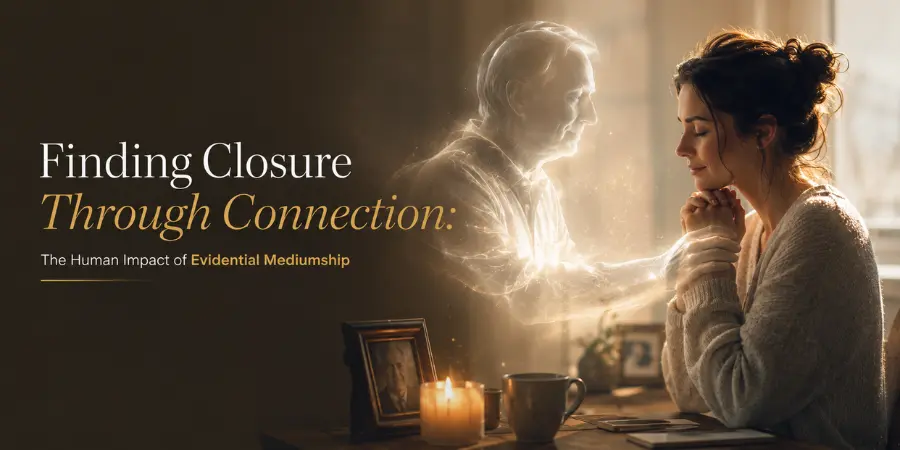
Finding closure through connection represents a genuinely human response to one of life’s most universal challenges: continuing to live fully after losing those we love most deeply. Evidential mediumship, practiced ethically and understood within appropriate frameworks, provides some bereaved individuals experiences of recognition, continued relationship, and meaning that significantly support their healing journeys.
The research is clear that these experiences create measurable positive impacts on grief outcomes for many recipients. Whether those impacts emerge from genuine communication with deceased individuals, from psychologically powerful meaning-making processes, or from mechanisms that current frameworks inadequately describe, their capacity to support human healing through profound loss deserves respectful, rigorous, and ongoing investigation. For the bereaved individuals whose lives are genuinely transformed through these experiences, the ultimate explanation matters less than the healing connection provides.